 Hi, I'm Heidi and I homeschool my two sweet kids. I want them to know that learning is an exciting lifelong adventure! We love great books, unit studies, notebooking, lapbooking, and hands-on learning.
10 Foods to Help You Feel Like a Pioneer
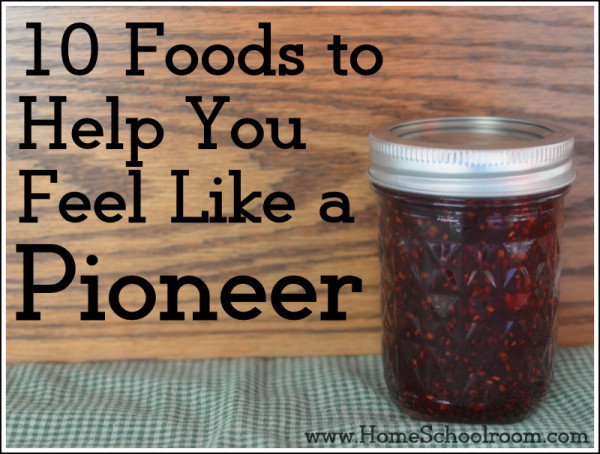
I am a homeschooler and I love to eat, so it should come as no surprise that I like to prepare foods that go along with our studies! I shared about the foods we ate during our study of the 50 States, and today I’m sharing foods we enjoyed during our study of the pioneers of the 1800s.
We actually had a few opportunities to focus on food from this time period: my daughter had a Little House themed birthday party, I shared about pioneer life for her Girl Scout troop, and we invited friends over for a chuck-wagon style dinner as an end of unit celebration.
Snacks and Sides:
1. Homemade Bread: I shared this recipe for simple whole wheat bread during my Tea Time post last week. It really is an easy to make homemade bread even for the novice bread-baker. It’s a great way to show the kids how much different it is to make bread from scratch rather than pick up a loaf at the store.
2. Homemade Butter: I’ve made butter with three groups of kids and it’s not only fun but gives them great insight into the work required for every little thing you ate before the days of supermarkets.
- Put some heavy cream into a glass jar with a tight-fitting lid. I use a canning jar and fill it about half full.
- Then shake, shake, shake! After a while you’ll see whipped cream in your jar.
- Keep shaking until you see yellow lumps.
- Keep shaking until you have a big yellow lump (butter) and some white liquid (buttermilk–save it to make pancakes with the next day!)
3. Canning: This isn’t a recipe for a certain food, but an activity I highly recommend you try with your kids. Make a batch of jam (strawberry, blackberry–anything!) or pickles. We’ve canned a few times and I’m always amazed at the amount of work. We work together on it, it takes half a day and makes a big mess, and we talk about how they had to preserve enough food to last them through the winter. If you’re a total novice, the Ball Complete Book of Home Preserving is a great guide that covers all the basics and has lots of recipes.
4. Cornbread: I’m partial to this recipe for honey cornbread from Allrecipes.com, but would love to try this authentic-looking recipe for Little House style cornbread that adds bacon grease and cooks in a cast iron skillet.
5. Apple Butter: This is a nice treat on a slice of homemade bread. We made ours in the oven using a recipe from American Kids in History: Pioneer Days (a great book, by the way, with lots of ideas for things to make, do, and eat). Allrecipes.com has a recipe for apple butter that cooks in the crockpot.
Main Course
A full pioneer style dinner calls for a simple and filling main course.
6. Beef Stew: Again, if we’re using bullion we’re cheating a bit, but this recipe for a fairly simple beef stew is a satisfying main course.
7. Baked Beans: This simple recipe for baked beans has ingredients pioneers might have had on hand. We use a recipe from my husband’s Aunt Alice. Hopefully I don’t get in trouble for giving out a secret family recipe!
- 2 pounds soldier beans
- 1/2 pound salt pork
- 1 medium onion
- 2 tsp dry mustard
- 3/4 cup brown sugar
- 1 1/2 cup maple syrup
- 1/2 cup molasses
Soak the beans overnight. In the morning boil them for 5-7 minutes. Add everything to a bean pot, add water just to cover and bake for 8 hours at 275 degrees. We don’t have a bean pot so we use a crock pot on low for 8-10 hours.
A Sweet Ending
8. Apple Pandowdy: I tried this recipe for Pandowdy. It’s sort of like a cobbler though messier looking, but in a bubbly and delicious sort of way.
9. Sugar on Snow: We had actually tried sugar on snow during our Maple Syrup unit study.
10. Pie, with a homemade crust: Does any one else love the convenience of the easy unroll-and-bake refrigerated pie crusts? For the pioneer experience make a pie crust from scratch and have the kids help you with the whole messy job. Fill it with apples or pumpkins (if you’re really adventurous you could skip canned pumpkin and prepare the pumpkin yourself) or for a main course try chicken pot pie. This pie crust recipe I learned at a pie-making class. (And forgive me for the shortening. I do try to avoid it!)
- 4 cups flour
- 1/2 cup sugar
- 1 teaspoon salt
- 1 3/4 cup shortening
- 1 egg
- 1 1/2 teaspoon lemon juice
- 1/2 cup water
Mix flour, sugar, salt and shortening by hand until it crumbles. Add wet ingredients just until mixed. Roll out and proceed with your yummy pie recipe. Makes four crusts.
Don’t forget to enlist your kids’ help preparing these foods from scratch–they’ll understand a little more about life for children during that time period. In truth we aren’t even getting the full experience since we didn’t have to grow and thresh the wheat to make our flour, or slaughter the animals, and Ma Ingalls certainly didn’t have nicely ground dried spices from the store or canned chicken stock. It may not be fully authentic but it helps us understand how much work was involved in making all their food–and that children had to help!
Hop over to iHomeschool network to see what other homeschool bloggers are cooking up.
This blog hop series was inspired by Angie of Many Little Blessings where you’re welcome to link up, too!
Scheduling Tea Time for the Extras and 10 Tea Time Snacks
As I’ve been taking the time to reflect on our last school year and iron out what my goals and plans are for next year one thing I’m really excited to institute is a tea time. I’m planning to use it as a time to focus on those lovely “extras” that are a hallmark of the Charlotte Mason style education. We’ll sit down together over a cup of tea and a treat and share poetry and fine art and music.
Anytime I read about other homeschool moms setting aside tea time I liked the idea of making it a special time in our day. Then when I read about Elevenses from Ellen at the Bluestocking Belle I realized the 11:00 time slot would be a good fit for us, too. It will work better than an afternoon tea-time, because often by afternoon we’re either heading to an activity or errands or I’m settling them in for Quiet Time (a daily habit I can’t do without). It also will be a good time to transition between their individual work that starts our day and the subjects we study together.
Step #1 to make this a special time to look forward to in our schedule is having a sweet edible treat. I’m conscious of it being a treat, but not too unhealthy. And although I enjoy baking some days are too busy and I don’t like to have large amounts of sweet baked goods in the pantry (because then I’m tempted to eat them all day long). My answer to those problems are baking things I can freeze. That way we’ll only keep out a little for our tea time and it will also give us variety because every few days we can pull something different from the freezer.
From A to Z here are my go-to freezer-friendly sweet treats I plan to keep stocked for our tea time.
#1 Apple Bread
I use the Apple Walnut Bread recipe from Allrecipes.com, minus the walnuts because my kids don’t like them. I just love the rustic nature of this sweet bread with chunks of apple. I cut the calories a bit by decreasing the oil to 1/2 cup and increasing the applesauce to 1/2 cup. The recipe yields two loaves.
#2 Banana Bread
This recipe comes from an old Canadian cookbook treasured by my mother. I made a few substitutions to make it a bit healthier and everyone still asks for the recipe. This recipe also yields two loaves.
- 2 cups mashed overripe bananas (5-6 bananas)
- 1 1/2 cups brown sugar
- 4 eggs
- 1/2 cup melted butter
- 1/4 cup applesauce
- 1 cup wheat flour
- 2 cups white flour
- 1/2 teaspoon salt
- 2 teaspoons baking soda
- 1 teaspoon vanilla
Mix bananas, sugar and eggs. Add butter, applesauce and vanilla; mix well. Sift together flour, salt and soda. Add to wet ingredients and mix well but don’t over-mix. Bake at 350 degrees for 45 minutes or until a toothpick inserted near the center comes out clean.
#3 Blueberry Muffins
These Blueberry Cream Muffins from Allrecipes.com are a family favorite. I use half brown sugar and half white sugar, and also increase the blueberries to 3 cups (you can add frozen berries right to the batter). It makes 24 muffins so I freeze as many as I can. After thawing I microwave them to make sure they are warm through, then pop them into the toaster oven for a minute–after that you’d swear they were fresh baked.
#4 Cinnamon Raisin Bread
This delicious homemade recipe for Cinnamon Raisin Bread from Allrecipes is a bit more work than most of these treats, but quite delicious. I cut the ingredients in half (because otherwise I think it would overload my Kitchenaid mixer) and it still makes two loaves. It does bake in less than the 45 minutes the recipe calls for, so be sure to check your bread early.
#5 Cranberry Bread
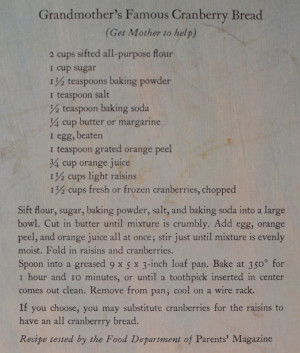
Have you every read Cranberry Thanksgiving? It’s a cute story, and on the back is the recipe for Grandma’s Famous Cranberry Bread. I’d tried several recipes before this that were not what I was looking for–this one is just right–just enough tart cranberry and orange flavor.
#6 Pumpkin Bread
This recipe for Downeast Maine Pumpkin Bread is terrific. And I’m not saying that just because I’m from Maine–I’m backed up by the 5,000 people who have reviewed it! It makes three loaves, so there is plenty to freeze.
#7 Rhubarb Bread
Every old garden in Maine has rhubarb growing in it. This recipe that was once listed in a local newspaper makes a delicious sweet bread from the tangy stalks.
- 1 1/2 cups packed brown sugar
- 2/3 cup vegetable oil
- 1 egg
- 1 cup buttermilk
- 1 tsp. salt
- 1 teaspoon baking soda
- 1 teaspoon vanilla
- 2 1/2 cups flour
- 2 cups diced rhubarb
Mix brown sugar and oil until smooth. Add egg, buttermilk, salt, soda, vanilla and flour. Blend until moist. Fold in rhubarb. Pour into two greased loaf pans and bake at 350 degrees for 50-55 minutes or until a toothpick inserted near the center comes out clean. (By the way, if you don’t have buttermilk just put one tablespoon of vinegar into a measuring cup, add milk to make 1 cup total liquid and let stand for 5 minutes before using.)
#8 Scotch Tea Muffins
These are plain muffins that are perfect for pairing with homemade jam. The recipe came from an old Canadian cookbook my mother treasures.
- 2 tablespoons butter
- 1 egg
- 4 cups flour
- dash salt
- 1 1/4 cups sugar
- 1 1/4 cups milk
- 4 teaspoons baking powder.
Mix dry ingredients. Then add wet ingredients. Bake at 350 degrees fro 15-20 minutes.
#9 Whole Wheat Bread
I love this Simple Whole Wheat Bread recipe from Allrecipes.com. It makes three loaves so the work involved really pays off and I’ve had wonderful luck with it. When I first started making it I tried freezing the dough before it rose at all, freezing after the first rise and freezing after it was baked. The already baked bread tasted wonderful from the freezer and the bonus: that was the easiest, too, because it can be taken right out of the freezer, thawed and enjoyed just like fresh baked. If anyone has frozen store-bought bread before you may notice the texture suffers after you thaw it. This is not the case with homemade bread–trust me!
#10 Zucchini Bread
And last, but certainly not least, a recipe for Zucchini Bread from Allrecipes.com. If your children balk at the idea just feed it to them first before you tell them what’s in it. My children love this bread.
What Will We Do During Tea Time?
- We’ll read poetry aloud with a goal of memorizing one poem each month.
- Homeschool Share has regular Tea Time posts with information and links for studying poets, composers, and artists.
- These next two resources have helped expose and educate me along with my children in subject areas that were challenging for me. I had almost no experience or knowledge in fine art and music and these resources from fellow homeschool moms are invaluable.
- Fine art and music appreciation is planned for you with Harmony Fine Arts. We’ll be using Grade 5 this year to go along with our history studies.
- Mary from Homegrown Learners shares her classic music appreciation technique of Super Quiet UnInterrupted Listening Time. I’m an affiliate for her just-released ebook with 10 SQUILT lessons because I honestly love this resource. The information she shares on each piece of music is crucial for me to share intelligently with my children. Click here to visit Homegrown Learners.
Hop over to iHomeschool network for more top ten lists.
This blog hop series was inspired by Angie of Many Little Blessings where you’re welcome to link up, too!
Summer Habit Training with a Weekly Schedule
After finishing up our second year of homeschooling with a week of testing, it was time for some relaxation. So for the past two weeks we’ve spent some time on the beautiful coast of Maine and taken some walks in the woods to refresh.
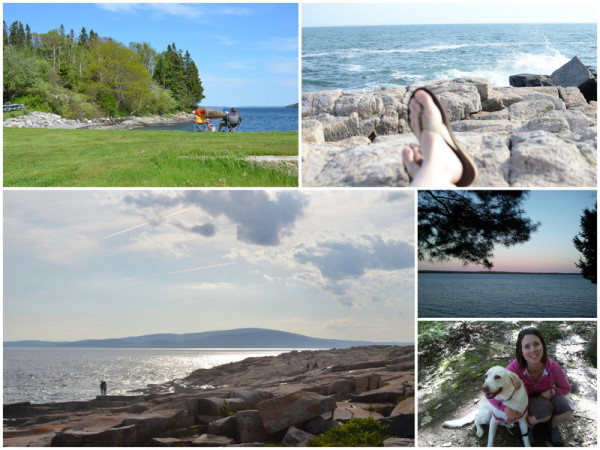
It was a great time for reflection on the past year–what went well and what needs some tweaking. I’ve been reading (and rereading) some of my favorite homeschooling books and grabbing some inspiration from my favorite blogs.
Time for Some Habit Training
Those of you familiar with Charlotte Mason’s methods know that a tool she advocates is the use of habits, and this is an area where we need some work. Which is really to say that I, as the mother, need some work.
The mother who takes pains to endow her children with good habits secures for herself smooth and easy days; while she who lets their habits take care of themselves has a weary life of endless friction with the children. ~ Charlotte Mason (Volume 1, p. 136)
I am often inspired by Barb’s wise council as a Charlotte Mason style homeschooler just graduating her third child. A post she wrote about instilling habits in her older children is full of ideas and advice and prompted me to focus on some housekeeping habits during our more relaxed summer schedule. I have been working on chores with my children, attempting to line up their responsibilities for taking care of their spaces and belongings and also contribute to overall household cleanliness. We have made some headway:
- They each have a checklist for getting ready in the morning, which is helpful in cutting down the numbers of times I have to say “Did you pick up your dirty clothes?” or “Did you turn off your bedroom light?” I still find myself having to remind them to go check their list for forgotten items, however, and with the list posted upstairs I can forget my responsibility to see that they have checked off the items. There is no record from day to day, so I feel the lines of habit have not been laid firmly enough for these daily tasks to become second nature.
- I added a daily household chore for each child. These are different each day and involve things like sweeping or wiping down bathroom counters and when done they really help keep the house cleaner during the week before my rounds of weekend deeper cleaning. I kept the list of specific chores on my desk, so here again I found myself forgetting to remind them and many days the chores went undone.
The room for improvement is making these tasks that they are fully capable of into a habit with no need for reminding by me. Taking care of these habits over the summer should let us focus on other habits when full time schoolwork picks up in the fall.
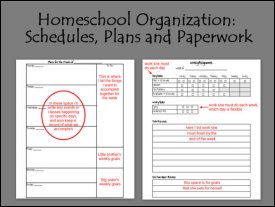
Last year I used a checklist for my daughter to increase independence in her school work and it worked very well. I modified the lists and made each of my children a summer weekly checklist.
Summer Weekly Schedule Checklist
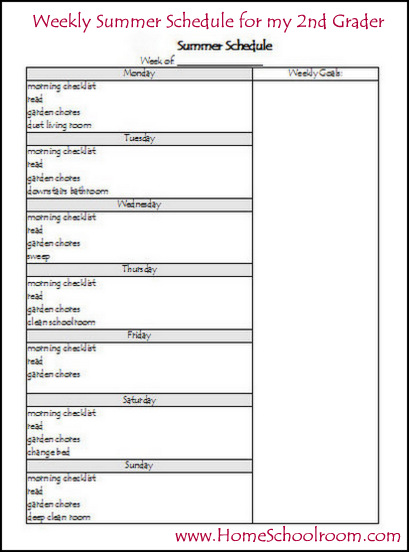
Each of them has daily tasks on their schedule:
- Morning checklist: the hope is this will cut down on me having to remind them to complete this list.
- Read: they have reading goals specific to their age, and this is here to make sure each of them reads every day.
- A household chore: again, with the item on their checklist I hope to cut down on the need for reminders from me.
- Garden chores: they each have their own square foot garden, so they need to weed and water it each day. My daughter showed extra interest in flowers this year so she also has several potted plants outside that will be her responsibility.
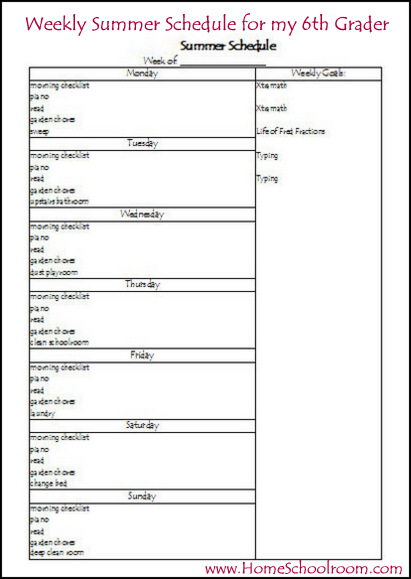
My daughter’s list has additional items:
- Daily piano practice
- Some tasks that need to happen 1-3 times per week but the day is up to her (Xtramath, a chapter in Life of Fred, and typing practice)
- I also plan to check in with her each Monday to help her in setting some personal goals she can add under “weekly goals.” I found this helps keep her productive in her free time. We set goals like making something (she sews and loves duct tape crafting) or organizing a section of her room (something she actually enjoys!) or writing a letter to someone (she has several girls she exchanges letters with).
These checklists give us all a central place to keep track of chores and also keep a record of how they are doing at accomplishing each item each day. The final piece is a reward for weekly lists with all items checked off. I’m still debating the specific reward–a trip to Dunkin’ Donuts for breakfast, or possibly good old cash.
In case any of you are also looking to make your life with your children easier by forming good habits Simply Charlotte Mason offers a free ebook that I just stumbled across today called Smooth and Easy Days. Do you have any specific summer goals for your children or any advice for me as we focus on habits?
Thank you to the wonderful hostesses with fun link-ups. Be sure to join the fun and see what other homeschoolers are up to!


10 Homeschooling Books to Encourage and Equip
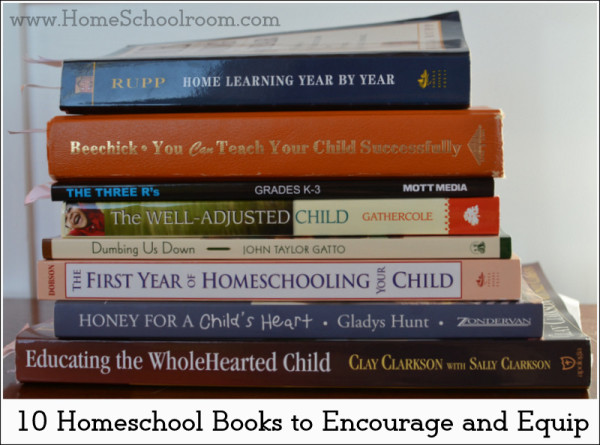
It’s time for another Top Ten post and the topic this week is homeschooling books. I am by no means an expert in this area and still wish I could take a month off just to read more books about homeschooling! In fact, that’s what I’ve been doing since we officially finished our school year about a week and a half ago. I want to share some of my favorites, which fall into two categories: the books that encouraged me to homeschool and those that equipped me to do it.
By the way, the book titles are Amazon Affiliate Links, but these are books I truly enjoyed.
#1 The Well-Adjusted Child: The Social Benefits of Homeschooling by Rachel Gathercole
Don’t laugh, but one of my arguments against homeschooling (you know, before I became one of those weirdos) was that kids had to go to school for socialization. My husband ordered several books when I was hyperventilating over the prospect of homeschooling and this was the first book I read. It opened my eyes to the fact that a bunch of same age kids in a room doesn’t lead to the kind of social skills I’m looking to create.
#2 Dumbing Us Down: The Hidden Curriculum of Compulsory Schooling by John Taylor Gatto
This was my second book, and my second a-ha moment. This was the one that I kept stopping as I was reading and remarking to my husband that we had to homeschool! It’s a fairly quick read at around 100 pages but really highlighted for me the negative aspects that can be found in public schools. (For example, changing subjects to the ringing of a bell makes no sense whatsoever in the real world.)
#3 The First Year of Homeschooling Your Child by Linda Dobson
Now that the first two books had convinced me that I did, indeed, want to homeschool my children, this was the first book I read that made me think I could actually accomplish it. My favorite parts of the book were many stories from homeschool families and the examples of different homeschool philosophies so I could begin to formulate my plan for educating my children. The book also deals with a lot of practical newbie help like taking a child out of public school (and the de-schooling that can be necessary) and learning styles.
#4 Home Learning Year by Year by Rebecca Rupp
This is another very practical choice. There is a chapter for each grade from preschool through high school, and each one details a course of study and even lists resources for covering the subjects. I continue to refer to this book, especially for math concepts to see that we’re covering age-appropriate skills. I appreciate the wide range of resources listed, from books to manipulatives to games to standard curriculum.
#5 Honey for a Child’s Heart by Gladys Hunt
Okay, so this isn’t actually a homeschooling book, but it had an impact on my homeschooling style and continues to be a reference I turn to so I wanted to list it here. Like the Read Aloud Handbook by Jim Trelease (which I also enjoyed, but comes in second to this book) it encourages reading aloud to children and sharing books as part of your family life. The first portion of the book discusses books and their importance, how to encourage your children to read and choosing books. The second half of the book contains book lists organized by age and topic. I have come to really trust her choices and the paragraph describing each book.
#6 Charlotte Mason’s Original Homeschooling Series
Though I am fairly eclectic in my homeschooling I admire many of Charlotte Mason’s philosophies and incorporate as much of them as I can. I have to admit I have not finished reading all six books in her original series. This is reading I save for when my brain is fresh and focused. I purchased the Kindle version once when it was available for around a dollar on Amazon so it was very little to spend to have her writing easily accessible. When I get a chance I read a few pages and I also use the highlight feature to keep track of particularly interesting or beneficial sections. Her original series and modern paraphrases are available for free online at Ambleside.org.
#7 For the Children’s Sake by Susan Schaeffer Macaulay
This book gave me an tremendously helpful overall idea of Charlotte Mason’s philosophy and helped me better understand the primary focus areas of her method. Understanding those primary areas gave me direction in planning my homeschool priorities.
#8 A Charlotte Mason Companion by Karen Andreola
This book is quite a bit longer but filled with practical advice on implementing every part of a Charlotte Mason style education. I read a copy from the library but intend to add it to my bookshelf so I can highlight and stick sticky notes in it and refer to it.
#9 Educating the WholeHearted Child by Clay and Sally Clarkson
I’d had my eye on this book for a while after reading many accolades, but was holding off because it wasn’t available at the library. I finally bought a copy and am glad I did–it is a large book loaded with information on many aspects of child-rearing and homeschooling. It is very much Christian-focused, which would come as no surprise to anyone familiar with the Clarksons. Their homeschool method has much in common with Charlotte Mason, and this book has a very practical modern-day focus for raising children today. My favorite parts are the focus on living books, natural and gentle education methods, and making your home work for your in your goals.
#10 The Three R’s and You Can Teach Your Child Successfully by Ruth Beechick
These are my newest reads and they easily joined my list of favorites. I found myself getting a little bogged down this year in long to-do lists and obsessing about curriculum choices and schedules. Ruth Beechick’s advice is so very practical and down to earth it would be hard not to be calmed by her style. The Three R’s covers Kindergarten to 3rd grade, while You Can Teach Your Child covers grades 4-8. Going over these books has already helped me simplify some of my plans for next year.
I love reading homeschooling books to fine-tune my style and encourage me in this lifestyle. What books have you loved that I should add to my summer reading pile?
I can’t wait to read the book lists of the other bloggers of iHomeschool network. Every Tuesday for the next 10 weeks I’ll be participating with the other bloggers of iHN in a blog hop of top ten lists.
This blog hop series was inspired by Angie of Many Little Blessings where you’re welcome to link up, too!
Hi, I'm Heidi and I homeschool my two sweet kids. I want them to know that learning is an exciting lifelong adventure! We love great books, unit studies, notebooking, lapbooking, and hands-on learning.