 Hi, I'm Heidi and I homeschool my two sweet kids. I want them to know that learning is an exciting lifelong adventure! We love great books, unit studies, notebooking, lapbooking, and hands-on learning.
Nature Study ~ Mesmerized by Monarch Metamorphosis
I really wanted to raise caterpillars into butterflies for the kids to watch. I really wanted them to be monarch caterpillars. We’d done it years ago and the amazing process is still etched in my mind but even my 10 year old’s memory of it is fuzzy. The caterpillar is striking and not hairy (my son got hives from a hairy caterpillar last year so both my kids now refuse to touch any caterpillars with hair), the chrysalis is like a jewel, and the butterfly is beautiful. The problem: I couldn’t justify the $26 in shipping charges to order monarch caterpillars.
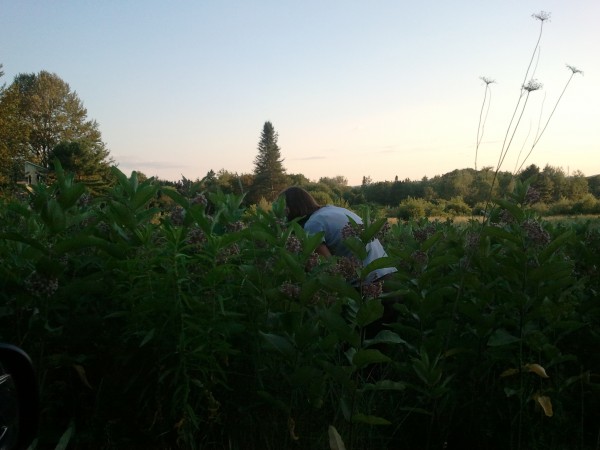
I was determined and, after looking at countless images online felt I could recognize milkweed–the only food monarch caterpillars will eat. This was one of those times when my husband just shook his head, because he knows I get an idea in my head and can’t let it go. He chuckled as I looked into roadside wildflowers on our walks and in the car. I took my family on some crazy back-road drives until I found a country road with tons of milkweed…and I went searching. Here’s me up to my waist in a field of milkweed, searching for teeny-tiny caterpillars. I would have been happy with eggs, too, but since they’re the size of the head of a pin I decided that just might be impossible. My family cheered me on from inside the bug-free car as I battled the mosquitos.
Finally–success! Two monarch caterpillars came home with us. The smallest one (dubbed “Little Guy”) was so tiny he was still whitish with a dark head. “Big Guy” was already getting the striped pattern characteristic of monarch caterpillars. We set them up right in the middle of our kitchen island. Yup, we’re homeschoolers.
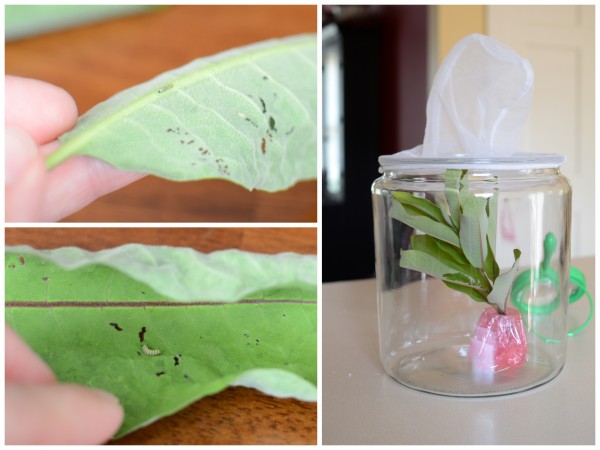
It was amazing how fast they grew! We had several opportunities to watch them molt. We were in awe of how much they could consume in a day, and how much frass (new vocabulary word for my son to avoid the common word for it) they could make.
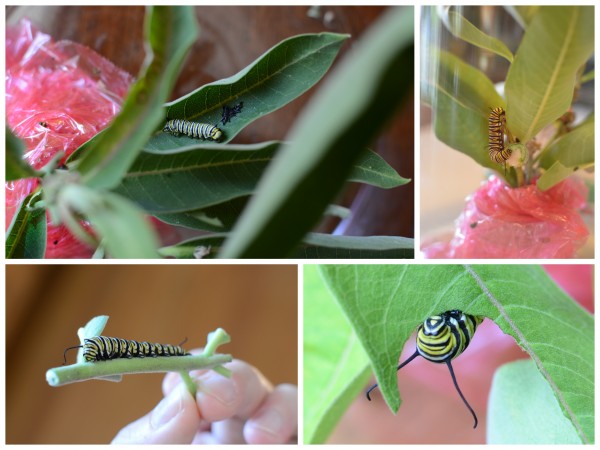
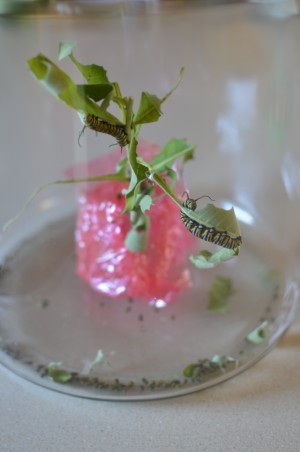
I found that keeping the stems in a small jar of water kept the leaves fresh enough to last a few days, since I had to drive to get leaves for them. One morning I woke up to this and had to go get more leaves before everyone was even out of bed!
Finally the moment we’d been waiting for: Big Guy moved to the top of the container, attached himself and hung upside down in a “J” shape. We watched with excitement but ended up missing the moment of transformation into a chrysalis!
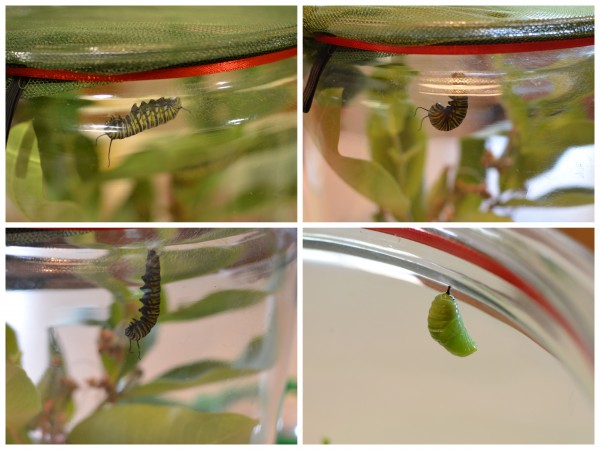
When it was Little Guy’s turn a couple days later my kids were determined not to miss it. I was afraid it would happen in the night and they didn’t want to go to bed. Mr. Tech Support (my husband) saved the day. He reminded me that the fancy camera he bought me can do time lapse photography, so we set it up to take photos all night long just in case. (Okay, maybe we’re crazy…but the kids were excited and I wanted them to sleep!)
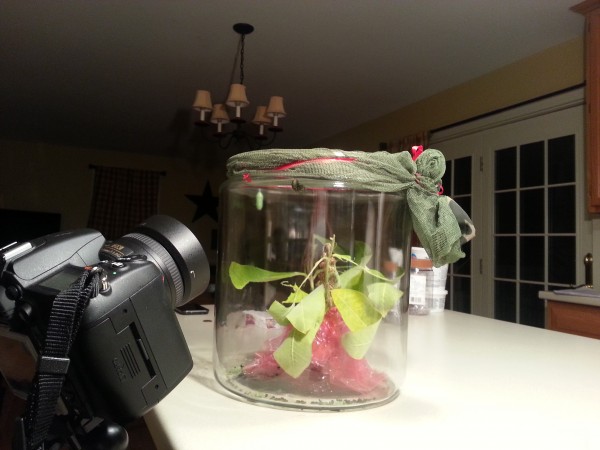
The caterpillar was still hanging in a J-shape the next morning so we set ourselves up to provide constant surveillance. I decided to keep the camera set up taking time lapse because it was really neat now that I’d figured out how to do it. (In fact, I may be taking time lapse photos of everything from science experiments to the cat napping. It’s fun!)
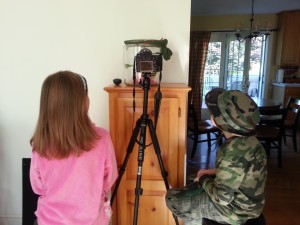
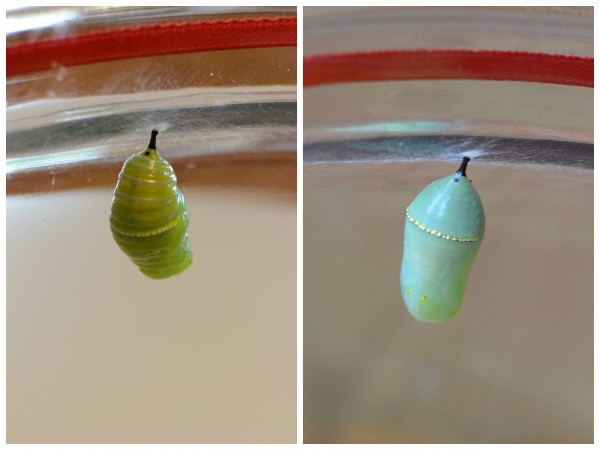
We made sure one of us had our eyes on it the whole time. Finally my daughter yelled and we witnessed the amazing transformation of this black, yellow, and white caterpillar with legs and antennae to a pale green chrysalis with a completely different shape. If you are interested here is my first amateur attempt at time-lapse photography:
We were amazed at the transformation, and how much the early pupae moved about to shed the old skin and attain its final form. Initially you could see the ridges from the caterpillar’s body and some striping, but the color changed and the chrysalis became more opaque. By the end it was a smooth, lovely shade of green. My favorite part are the markings that look like drops of gold paint. Truly amazing.
As we’ve been mesmerized by this process we’ve learned a lot about monarchs and butterflies in general using these resources:
- Real Science Odyssey Life Level One: Our new science curriculum had a unit on insects with specific labs about caterpillars and butterflies, so we did the corresponding lessons and journal pages. It meant working out of order but we had to work with nature on this one!
- Go-Along books:- It’s a Butterfly’s Lifeby Irene Kelly: This book has great information on all kinds of butterflies with beautiful drawings, and also fun facts about defense mechanisms and frass (both of particular interest to a six-year-old boy).- The Magic School Bus and the Butterfly Bunch: A good book for covering the life cycle of butterflies.- National Geographic Kids Great Migrations: Butterflies by Laura Marsh: This book has terrific photographs to illustrate the migration of monarch butterflies, a truly amazing feat.
- Magic School Bus episode “The Butterfly and the Bog Beast” (on our Bugs, Bugs, Bugs! DVD): The Magic School Bus show is a favorite around here. This episode gives great information on how butterflies are tough little creatures with many defenses.
- We used just about everything Barb put out for the Outdoor Hour Challenge on monarch butterflies. I highly recommend the You Tube vidoes on monarch migration–it really is an amazing journey! We enjoyed all of the links under “suggested resources to view or print” from learner.org. They have easy-to-understand information on monarchs and their annual cycle, and the link about wings was information we hadn’t read elsewhere. The corresponding information from the Handbook of Nature Study led to some microscope fun: we pulled out our pocket microscopes after I found these unfortunate guys in our garage.
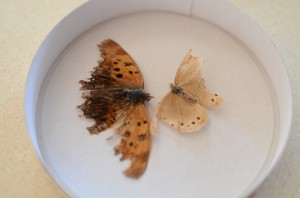 We’d read how the wings are covered with scales arranged in perfect rows, so it was wonderful to see for ourselves. It was also neat to read about the actions of the antennae when the caterpillar is frightened, something we’d observed when we spoke too loudly near the top of their glass container.
So now we anxiously await our butterflies. We think of Big Guy and Little Guy just under that green covering, preparing to become creatures that can fly. The transformation takes 10-14 days. This has been an amazing study, and for our family reinforced the wonders of God’s creation. I’ll be sure to update with photos when our butterflies emerge!
***Updated: Here is the post on our Monarch butterflies emerging and being released into nature!***
I’m submitting this to Barb’s Outdoor Hour Challenge Blog Carnival. Be sure to visit her site for nature study ideas, and watch for her blog carnival to see all the amazing summer nature study happening.
Our Homeschool Journal: a Fort, a Farm, and Family Fun
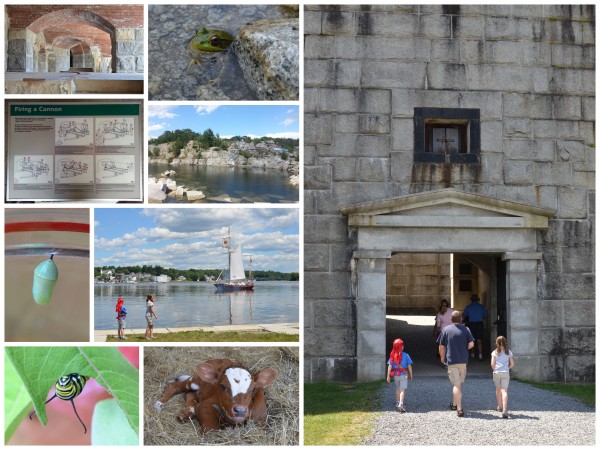
In our homeschool this week…
We finally hit our summer groove (I know, it’s almost time for heading back to school full time!): having lots of fun enjoying summer weather and activities, but still accomplishing the schoolwork that I had planned. The favorite at-home school activity was watching our monarch caterpillars form a chrysalis (much more to share about that in another post).
Places we’re going and people we’re seeing…
One thing I love about summer in Maine is the plethora of free or low-cost activities. Maybe it just seems like so many activities because our warm season is short and everyone is trying to fit things in! Anyway, we had a couple very educational days on the road this week. The first was “Pirate Day” at Fort Knox, a historic fort we usually visit each year anyway. An organization put on a show pretending to attack the fort under cannon fire. The pirate activities were fine, but my kids ended up having much more fun just exploring the fort: cannons, amazing stonework, passages you could get lost in, powder magazines…what’s not to love? A sign at the fort mentioned that the granite to build it came from a mountain nearby, so we drove there and hiked up to the quarry. It was amazing to see masses of granite and talk about how those square blocks of granite for the fort had been made. Plus the pond that formed in the excavation hole was home to some very cute frogs.
Another day was Open Farm Day in Maine, a day when farmers all over the state open their doors to the public for tours. We headed to an organic dairy farm, where the farmer was incredibly nice and filled our heads with what it’s like to run a small dairy farm including milking, making cheese and yogurt, and selling products at Farmer’s Markets. My summary: a whole lot of hard work.
My favorite activity this week was…
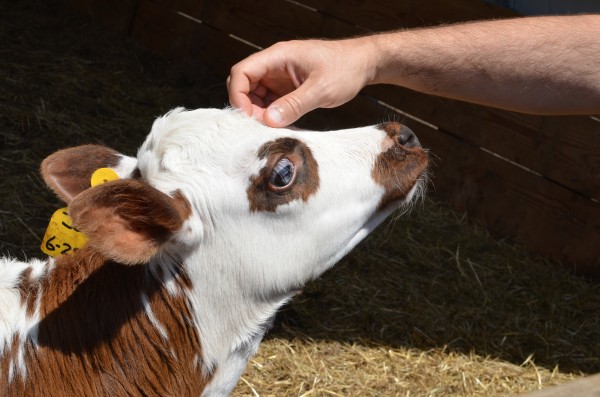
My favorite activity was most definitely being licked by a cute little calf at the dairy farm. Jo-Jo the calf was only about a month old, and for some reason loved licking us. This had us all in stitches, but I drew the line when Jo-Jo got to my elbow and began to nibble.
My favorite resource this week…
A new-to-me app called Mathopolis has both my kids practicing their math facts in their spare time. Really! Math facts during free time, isn’t that what homeschool moms dream about?
What’s working and not working for us…
Finally getting all the schoolwork I had planned for this week checked off my list (for the first time all summer) is completely working for me! I love lists, and especially love crossing things off. What’s not working is going to bed too late trying to catch up on my other lists.
Things I’m working on…
Finalizing next year’s curriculum is at the top of my to-do list. I’m SO close…just rethinking math and ironing out scheduling.
I’m reading…
The kids and I are reading the Little House series aloud together and right now we’re enjoying Farmer Boy. I’m going back through Home Learning Year By Year by Rebecca Rupp and Honey for Child’s Heart by Gladys Hunt as I formalize my plans for the year.
I’m grateful for…
A camping trip with my parents this weekend…and that there isn’t torrential rain in the weather forecast like there has been for our two other trips so far this summer. We love camping, and a trip with Grandma and Grandpa is double the fun!
Thank you to the wonderful hostesses with fun link-ups on Fridays. Be sure to join the fun and see what other homeschoolers are up to!

Review: Mathopolis App for Practicing Math Facts
I just have to share the new-to-me-app that I purchased last night. It may win the prize for the best educational app I’ve ever purchased. We’ve tried a few apps for math facts, and so far none have been a hit with my daughter. I sat down yesterday to try and find another app for my daughter to practice her multiplication facts. I am still a big fan of XtraMath, but I wanted a fun way for her to practice multiplication facts so when she gets to that level in XtraMath she will be able to progress quickly. I happened upon Mathopolis, and I am in love.
Mathopolis is a firefighter-themed app for practicing all math facts. We have an iphone, iPad and an iPod touch (all hand-me-downs, thanks to my husband’s tech-loving family) and this app works on all of them. On each device we can create multiple “firefighters,” which is especially helpful because you earn medals as you complete levels. You begin by choosing “play” to work on timed levels and earn medals, or “training” to be able to practice without being timed.
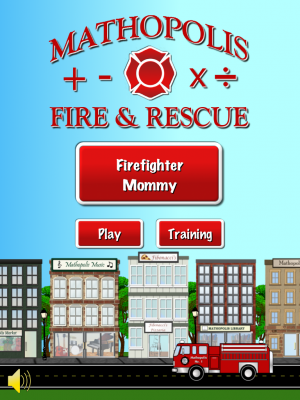
I love the many options in this app: just one operation at a time, or combinations of operations. Great practice!
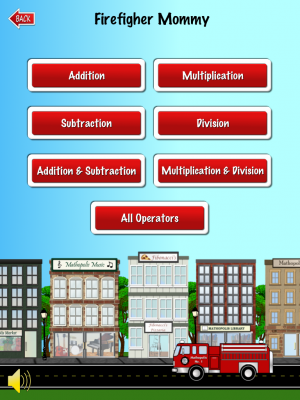
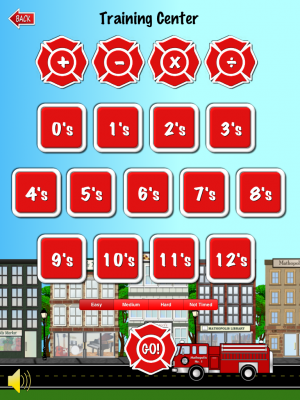
This is the “training” menu where you can choose which operation, which facts, and whether or not you want to be timed.
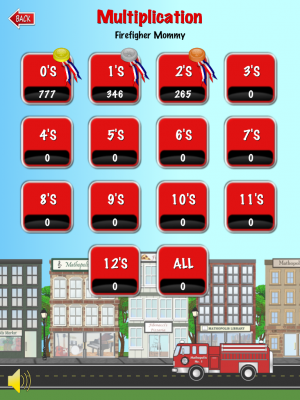
This playing menu shows any medals already earned. I like that there is a choice to practice all multiplication facts together.
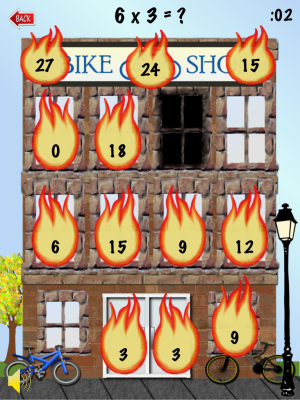
Here you see the screen while in play: a math fact appears, you touch the window with the answer before the clock runs out. Wrong answers mean you won’t earn a medal that round. You can even ask to see the missed problems at the end.
What we love:
This is an easy to use app that still provides lots of options for practicing math facts. The basic game is simple and nearly all the time is spent practicing facts. No time is wasted on other aspects of a game, or only doing the math facts to earn a separate, non-educational game. It is simple but both of my children love it. The biggest surprise: my daughter, who never chooses math as a “spare time” activity, picked up the iPad today to try to earn a few more medals. I’d have done a cartwheel if I didn’t worry I’d pull a muscle!
What we didn’t like:
Nothing. That’s a real rarity for me, as I’m usually quite picky about apps. I often don’t buy the in-app upgrades, and delete apps on a regular basis. Mathopolis is only 99 cents and is worth every penny!
Why I Was Wrong About the Kindle
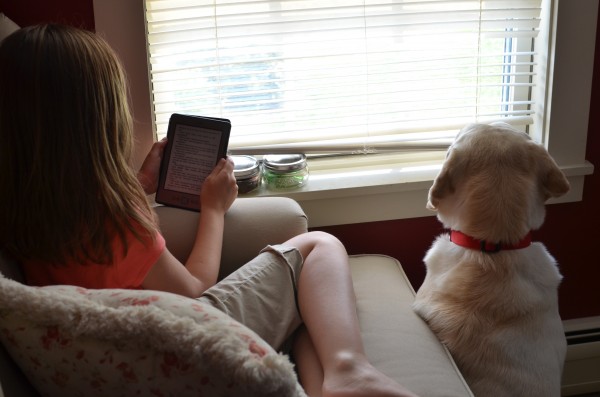
Conversations about incorporating new technology, be it software or hardware, in our house often go something like this:
My husband, fondly known as Mr. Tech Support: “Hey Heidi, I think you (or the kids) could benefit from [insert name of new technology here].”
Me: “No, no, I don’t think we need any new technology. In fact, there’s too much technology around here…whatever happened to the good old days where families grew all their own food and everyone sat around the wood stove at night? Those were simpler times. By the way, I’m thinking about getting chickens.”
Being the supremely patient husband that he is, he’ll just nod and smile. If he really thinks we should try it he’ll have a go at talking me into it again after I’m done looking at chicken coop plans online. This is when I launch into my litany of reasons why [insert name of new technology here] is actually evil. Again, he’ll smile smile and nod.
And…inevitably he’s right. I have fought everything from online banking to Google calendar to smartphones, all things I now couldn’t live without. Where does this fear come from? Maybe it’s hereditary: his grandmother was on Facebook and played poker on line while my grandmother never owned a computer. Perhaps I come from a long line of people with new-technology-phobia. Lucky for me (and my kids) I married a tech guru and he holds my hand all the way.
Back to the reason for this post: the Kindle. I fought this one for months and I felt like I’d accrued a pretty good list of reasons against getting one for our 10 year old daughter. Same routine: he’d mentioned it several times, I didn’t even research it but just said it was evil and would mean the death of all books (or something like that). I had my reasons against it and, as usual, it turns out I was completely wrong.
Reason number one (I was really proud of this one and used it first whenever the topic arose): “Oh, the eye strain!” This one is completely false. I had to see one in real life to be astounded by how an electronic screen can look just like a piece of paper. It doesn’t glow or have lighting or look like an iPad screen. It causes no more eye strain than reading a paper book for hours on end–something I was prone to do as a child.
My back-up reason: She won’t be reading real books, or quality literature. I was really off here. Okay, so it won’t be a paper book, but they are real books. And once we download them from most sources she can keep them on her kindle (it can store over a thousand books) so she can re-read them anytime. And here was the kicker: many older classic books are FREE so we were able to load her Kindle up with the good stuff. She’s already finished two classics that were on the list of books I wanted her to read. She is reading even more and instead of picking the newest looking book with a cute cover design at the library she’s picking up a classic. Bonus good point: she likes reading several books at once. With the Kindle she can bring those books with her camping or anywhere we go while taking up almost no space.
The last selling point, and something I hadn’t been open-minded enough to research and figure out, was the built-in dictionary. Yes, it’s valuable to be able to look up words in a paper dictionary, but who stops while reading a good book to do that? Well, on her kindle she just places her cursor over a word and sees the dictionary definition. She’s been telling us the meaning of words she has looked up, and we’re making it into a casual “word of the day” routine where she picks one for us all to try and use.
So, I was wrong. She’s not walking around with bloodshot eyes. She’s actually reading great books and enlarging her vocabulary all the while. Score another one for Mr. Tech Support.
Last Child in the Woods ~ Nature in our Homeschool
I’m here with my thoughts on Chapters 15-17 of the book Last Child in the Woods by Richard Louv. I’m participating in a book study hosted by Nicole of Journey to Excellence, be sure to visit her to read her thoughts on these chapters.
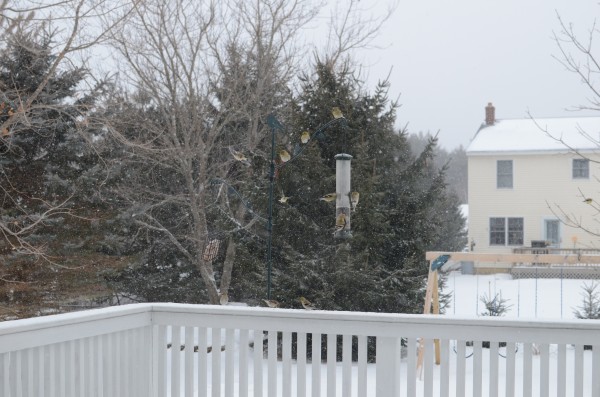
Chapter 15 discusses activities that offer a reason and focus for being in nature. Birding and nature journaling were two that we have enjoyed so far. Bird watching is one that my children and I had the pleasure of trying this past winter when we participated in the Great Backyard Bird Count. We prepared by learning about the birds in our area, then over the weekend of the GBBC we enjoyed our roles as scientists tallying birds and submitting our numbers to Cornell University. It occurs in the dead of winter here in Maine and it was great to have a nature-related activity to focus on. Nature journaling is another new-to-us activity mentioned in the book, and we’re all enjoying that through the recommendations of (once again) Barb at the Handbook of Nature Study blog. We often use her notebooking pages for some direction on what to draw. I have found that drawing an item really helps my children pay attention to the details.
At the beginning of Chapter 16 when I read the statement that teachers should free kids from classrooms I said to myself–that’s my whole philosophy behind homeschooling! Not just so they can experience nature, but the world and its people and places. Then on page 211 there was a quote from a teacher: “This isn’t memorizing information for a test…this experience becomes part of you.” Hello! Again, this is the core of homeschooling for me. For me, school was about memorizing information for a test and then promptly forgetting it! I hope to show my kids a different experience.
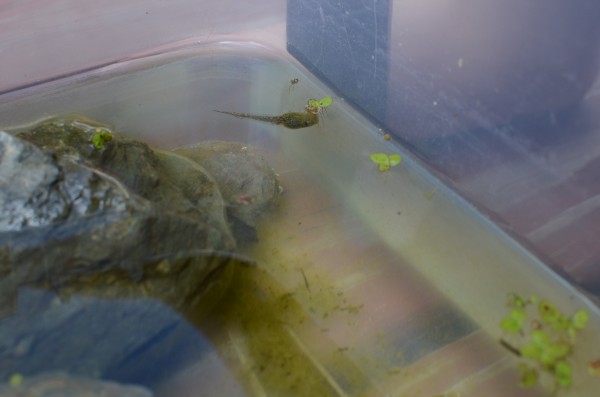
This chapter discusses many hands-on nature programs and the success of the students in them. I was thrilled because many of the ideas mentioned are happening somewhere in our home right now–square foot gardening in the backyard, caterpillars growing fat on the kitchen counter, and tadpoles just beginning to get their legs on the deck. This is what science is all about for us at the elementary level: things that the kids can see and touch and be amazed at.
The last quote again hit me as a comment on homeschooling in general: “An environment-based education movement–at all levels of education–will help students realize that school isn’t supposed to be a polite form of incarceration, but a portal to the wider world.”
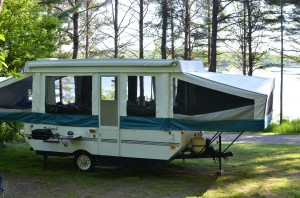
Chapter 17 talks about summer camps being a way to make nature more accessible to kids, and a lot of that discussion wasn’t really relevant for me. For our family, camping together at state parks provides the beneficial experiences and works for us while my kids are fairly young. We aren’t staying in a fancy camper with a bathroom, air-conditioning and television. It’s a pop-up with no plumbing, wooded campsites, and sleeping with the windows open.
I was interested in the author’s discussion of schools spending so much money on soon-to-be-obsolete electronics when they should spend it on natural areas where teachers can take their students to learn with all five senses. Case in point: our town just built a gigantic new high school surrounded by huge parking lots and athletic turf and running tracks. There is no natural area to spend time in, the library is smaller than before, and yet students will receive iPads to use. I also found out the other day that our middle school children have no recess at all. None. Parents were surprised that I thought this was sad! It didn’t seem to bother them that 12 year old kids don’t have time for recess or even 15 minutes of fresh air.
These chapters mark the end of the section of the book with ways to connect your children with nature at home and through their education. The next section is dedicated to ushering in what the author calls the “Fourth Frontier:” reconnecting our society as a whole with nature.
Last Child in the Woods ~ Stepping Back
I’m continuing on in the book study on Last Child in the Woods by Richard Louv hosted by Nicole of Journey to Excellence. Be sure to click over and read her thoughts on Chapters 12, 13 and 14. We’re getting to the part of the book with ideas on reuniting your child with nature.
The main thought to hit me during Chapter 12 came when the author stated that we should strive to make the experience in nature as unorganized as possible while still meaningful. I am a list-making lesson-planning micro-manager, so I have to fight my personality here. The message came again in a quote from E.O. Wilson: “Hands-on experience at the critical time, not systematic knowledge, is what counts in the making of a naturalist.” Ouch. Then in two different posts Barb (from Harmony Art Mom) used these quotes from Charlotte Mason:
Children are quick. In fifteen minutes, they will have finished with their sight-seeing exercise or imaginary picture painting. Other than that, an occasional discovery that the mother shows them with a name and maybe a dozen words about it at just the right time are all that’s needed; the children will have formed an interest in something they can continue on their own. Just one or two of these discoveries should happen in any given day.” Charlotte Mason, volume 6 page 78
They must be left to themselves for a good part of the day to take in their own impressions of nature’s beauty. There’s nothing worse than children being deprived of every moment to wonder and dream within their own minds because teachers and adults are constantly talking at them, not leaving them a moment’s peace. Yet, the mother must not miss this opportunity of being outdoors to train the children to have seeing eyes, hearing ears and seeds of truth deposited into their minds to grow and blossom on their own in the secret chambers of their imaginations.” Charlotte Mason, volume 1 page 44
I adore nature study and it is a highlight of for all of us, but I need to beware of making every moment in nature an official study and thereby not giving my children a moment’s peace to enjoy and experience nature for themselves. I like the description: a dozen words at just the right time.
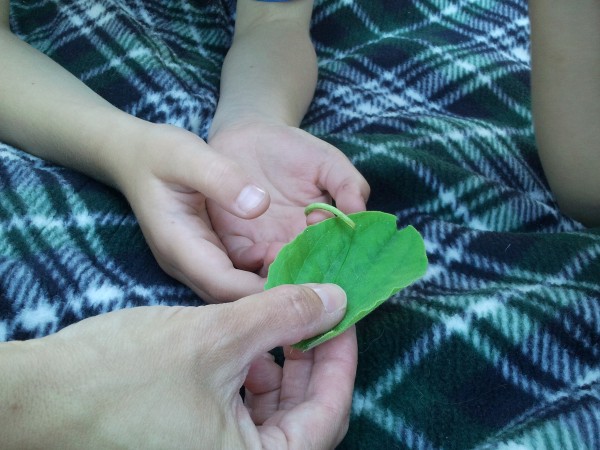
Chapter 13 reiterates the message: don’t make time in nature a chore or another “Fine Educational Opportunity” (love the terms!). There are many ideas in this chapter to connect your kids with nature, beginning with connecting yourself with nature and letting your enjoyment be contagious. Among the many ideas for great activities to do with your kids (the with is important) he talks about making walks a mutual adventure, not a forced march. Here I’m guilty again, at least at times. Believe it or not, I may have been better about some of this before I was homeschooling. When I wasn’t trying to teach them everything under the sun all the while having a way to show that they learned it I was a little (okay, a lot) more relaxed with our time. The good news for me: after reading this book we have been getting outside more already, and through homeschooling and nature study I’m reconnecting with nature. Nature study has rekindled my interest and excitement about the natural world. As I enjoy learning all I can, I need to remember my children’s ages and Charlotte Mason’s edict: just a dozen words to them, not unloading all the fascinating information I’ve read. I have a lot more work to do on my approach, but I am happy for the curiosity and excitement I see in my kids. As we sat at a lake this week my son kept bringing things to me that he thought were exciting (water lily flowers and seed pods, various dead insects) and he knew I’d be excited to see them, too.
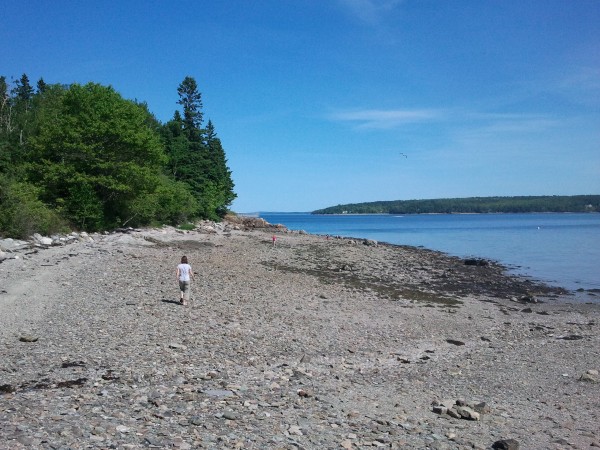
Chapter 14, entitled “Scared Smart” dealt with parents’ fears about kids being out in nature. As I’ve mentioned, I am a worrier so this is a difficult area for me. The author suggests that time in nature can foster “hyperawareness,” accentuating their senses and teaching them to pay more attention to their surroundings while also increasing their self confidence, leading to kids who are safer all around. The worrier in me did feel better when he talked about having them be with friends and have cell phones when going beyond our eyesight. My kids are too young for cell phones, but I am trying to tweak things a bit. I’ve had the opportunity a couple times to use the method he calls controlled risk: giving some physical distance, so even though I keep them within eyesight they get a little more of a solitary feeling. That’s me in the photo below, they’re walking along the beach ahead of me. Baby steps, right?
So my take-home message this week, in short, is to take a step back: don’t hover and don’t talk at them the whole time. Come back next week for Chapters 15, 16 and 17. The next chapters have more information on connecting your child with nature, both in daily life and in their education.
2012 ~ Summer Curriculum and Plans
I hadn’t planned it ahead of time, but we ended up having a relaxed school month for June. We did fun read alouds (Matilda by Roald Dahl had us in stitches), began new journals, and kept going with nature study, but most other schoolwork took a back seat. We camped (twice), had a three-week visit from my brother-in-law who lives abroad, worked in the garden, and enjoyed many summer activities. I knew after our more rigid schedule for April and May that we would all be ready to take some time off, but I didn’t think it would be a month before I’d have my summer plans ironed out, my lists made (for myself and the kids) and be ready to dive in.
The good news? It’s July, I am ready with my plans, and it felt good to get back into a routine. My daughter cheered when I said we’d be making a minibook today, and my son ran to dress up as a pirate when I said it would be about the Barbary Pirates. That’s a good reaction for our first day back in the saddle!
Though we homeschool year-round, summer is a time we enjoy a more relaxed schedule, fitting in schoolwork around the weather and fun times camping and boating and playing with friends. Last summer we averaged about two days of school per week, broken up in chunks of a couple hours here and there. Most of what I have planned for this summer are things we’ll study together (a favorite in our house). I do have a bit of individual work for each of them just to prevent any “summer slide” in areas where that is a concern. Here’s the plan:
Big Sister’s Fourth Grade Individual Work:
- Math: She will log in to Khan Academy twice a week to work on new material and any topics that come up for review. I love how Khan automatically puts topics up for review, and has the student answer questions correctly to take it off the list! I also will have her work on Xtramath (you can read my post about Xtramath here) three times a week. We’ll keep plugging away at these math facts until they’re solid as a rock in her brain.
- Piano: No break from piano lessons (not that she would want one) so she will continue to practice 30 minutes each day.
Little Brother’s First Grade Individual Work:
- Funnix: He is making good progress as a beginning reader using the Funnix reading program so we will continue throughout the summer. My goal is 2-3 lessons a week.
- Math: Playing store and other math games to practice telling time and addition and subtraction.
Together Studies:
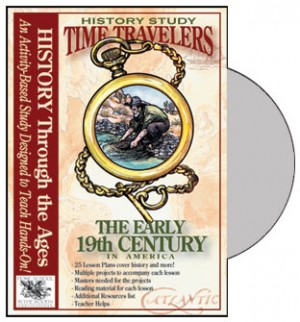
- History: We spent last summer studying the Revolutionary War, then backtracked a bit and studied the early explorers and Pilgrims in the fall. After that we would touch on history topics as they came up during our study of the fifty states, but history was not the focus as much as geography and modern life. I was anxious to focus on history again and though I knew the time period I wanted (post-Revolutionary War & Westward Expansion) I was unsure how to go about it. I decided on a Time Travelers unit from Homeschool in the Woods on the early 19th Century. My initial plan was to use this study just through the summer. Now that I’ve had a chance to go through it, I see there are so many wonderful topics and activities that I don’t want to rush through. I plan to add in Charlotte Mason-style living books when possible. Since it isn’t the only thing we’ll be working on I believe we’ll continue with this well into the fall. I’ll post a more thorough review of the Time Travelers unit when we’ve had a chance to work with it.
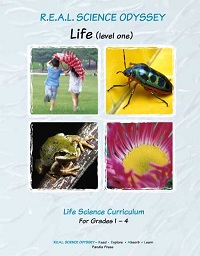
- Science: Nature Study has become an integral part of our homeschool, and a key piece of my children’s science education. We have thoroughly enjoyed and will continue using the ideas from Barb’s Handbook of Nature Study blog and her Outdoor Hour Challenges. As I mentioned in my review of our last school year, I wanted to spend even more time on science. My son has been begging me to learn about the human body, so I worked on putting together a unit study. As summer neared, our homeschool group’s science teacher quit, and I formalized my desire to cover more science basics, I decided I wanted to try an official science curriculum. I requested and received a free copy of Real Science Odyssey’s Life Level One program: the age range is perfect, it’s hands-on, and it includes a study of the human body. I’ll be posting a full review as we work with it. It is a year-long program so it should work well to start now and continue throughout the school year, especially since I plan to slow down as we hit the human body topic and use some of the other resources I’d already put together for a unit study.
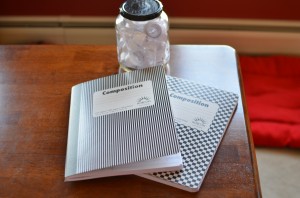
- Journals: I’d seen a great idea for a journal jar and wanted to use a similar plan. Last summer the kids wrote in journals often, but during the busier school year regular journal writing fell by the wayside. I think summer is a great time to jump back in. I didn’t print the journal prompts provided in that link, but looked through the prompts and picked the ones I liked, added a few of my own, then typed up a list of prompts and put them in a jar. They are all questions about them: likes/dislikes, special memories, plans for the future, what would you do with one million dollars, that kind of thing. I hope with the journal jar it will not only be fun, but a great keepsake for years to come.
- Reading Aloud: This one is sort of a given for homeschoolers, right? In fact, we’ve enjoyed reading aloud since my oldest was a baby. But two things have placed reading aloud in the forefront for me. I’ll be doing a post on this later and let you know what two resources moved this from a filler spot to a do-first-even-if-you-don’t-get-anything-else-done spot. First on our reading list is going to be the Little House series since it’s a great go-along for our history studies. I still read picture books frequently: some nonfiction science and history books, but many just because they’re fun.
Last Child in the Woods ~ Barriers to Free Play in Nature
I’m chiming in again in Nicole’s book study on Last Child in the Woods from Richard Louv. Be sure to visit her post to read her thoughts and those of others participating in this book study. This post covers chapters 9-11, which are in the section of the book dealing with why kids don’t play outside.
Chapter 9 had me nodding my head all over again with its discussion of over-scheduled kids. This topic had already come to my mind while reading this book, as I mentioned in my post on chapters 5-8. Not only is there less time for recess during school, but homework, lessons and other organized activities take up much of the time left after school. Like I said, I’m happy for the chance to homeschool. I can prioritize my child’s time to allow for the things that are important. Nicole mentioned the suggestion on page 121 in her post, and that was just what I needed, too: take time in nature out of the leisure column and put it in the health column. I love to make lists and check things off, and often have a hard time relaxing and not feeling like I’m accomplishing something. After reading all the chapters on the benefits to time in nature, I am hopeful I can view unstructured time outside as just as necessary for the kids as working on math and not let it fall by the wayside if we’re busy.
Chapter 10 is a little harder for me. I agree with much of it. I know the chances are very low that someone will abduct my child as they ride their bike down the street. But I am a worrier and don’t see myself being able to relax a lot in this department. As I discussed in my last post I hope to add more natural elements to our yard, along with giving my kids more time outside without me orchestrating activities. I can’t see myself letting them roam the neighborhood out of our yard, or head into the woods without me, but I can try to take them there more myself and maybe hang back a bit. Baby steps, right?
Chapter 11 was an interesting one. I had mentioned in my first post of this book study that I’d been incorporating nature study quite a bit, and hoped to do so even more. This chapter really cemented that plan for me. The discussion of how abstract many children’s nature education is rang true with me: in school it’s “Go Green!” and recycle, and learning about rainforest destruction or endangered animals, but “nature” is still a concept they are just seeing in a book or show. They aren’t out in it experiencing it and falling in love with it. This is how you really improve environmental issues, not by teaching them about things far away that they can’t see, touch and smell for themselves. I liked the quote from biologist Elaine Brooks on p. 141: “Humans seldom value what they cannot name.” So if kids can identify Pokemon characters better than native plants, what do you think they value the most? I wanted to incorporate more science education in our homeschool, and I realized after reading this chapter that the nature study that we already enjoy can be a big piece of their science education, not something separate that I fit in only if we have time. I just have to mention Barb at the Handbook of Nature Study blog while I’m on this topic because ideas from her blog are the how of nature study for us.
I’m really enjoying this book. Now that I’ve been persuaded of the importance of time in nature I am excited to delve into the parts of the book with ideas for implementation of a nature-child reunion!
Hi, I'm Heidi and I homeschool my two sweet kids. I want them to know that learning is an exciting lifelong adventure! We love great books, unit studies, notebooking, lapbooking, and hands-on learning.