 Hi, I'm Heidi and I homeschool my two sweet kids. I want them to know that learning is an exciting lifelong adventure! We love great books, unit studies, notebooking, lapbooking, and hands-on learning.
Nature Study ~ Exploring the Beach
We had tremendous opportunities for nature study while camping at our favorite spot on the Maine coast this week. Learning while camping…that’s what I love about homeschooling!
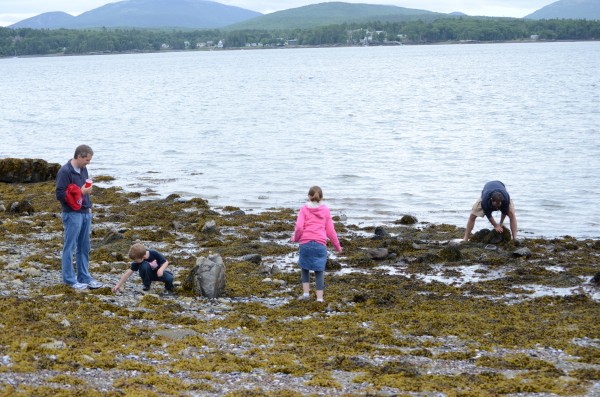
A beloved uncle was along for the trip and dazzled the kids with his ability to find creatures to observe. Even my usually squeamish daughter was holding and touching everything. I stood by with my camera attempting to capture all the amazing creatures and the wonder the kids had holding and touching them. We had done a Homeschool Share unit study on oceans last year and learned about some of these same creatures, but there is nothing like a hands-on experience! Barb talked in her newsletter about children being able to remember their experiences at the ocean beach years later, and I am confident this morning of exploring with all their senses will stick with them for a long time.
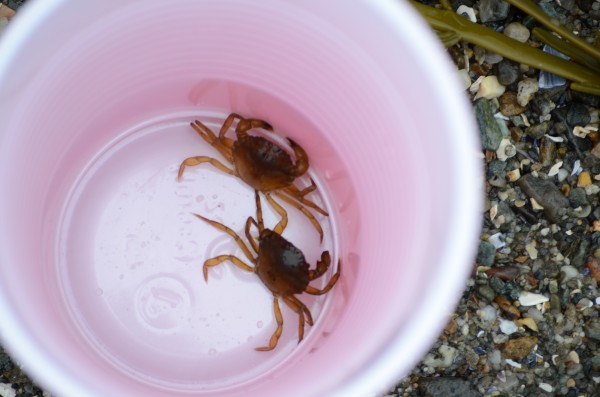
There were lots of crabs. It was interesting to feel the differences in their shells–some were quite soft from molting recently.
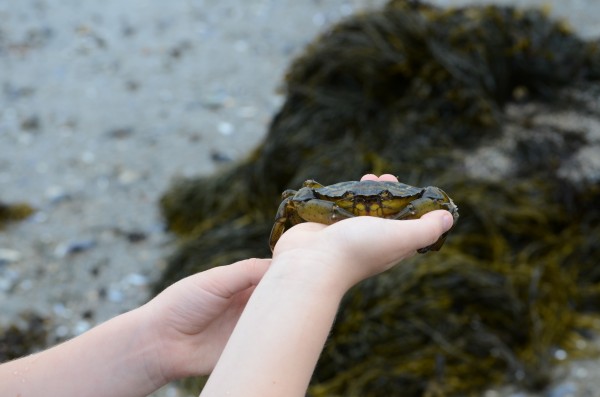
They found many different sizes.
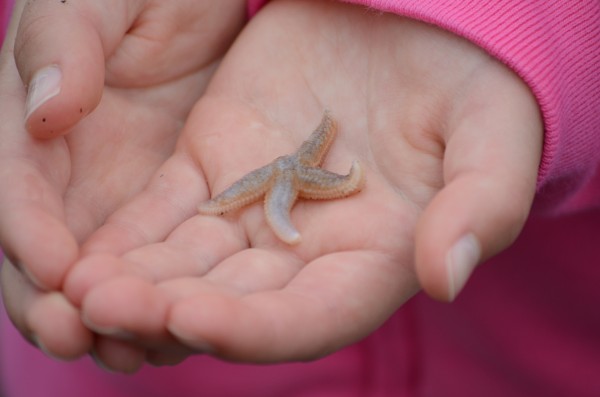
The sea stars may have been my favorite. Seeing their tube feet move around up close was amazing.
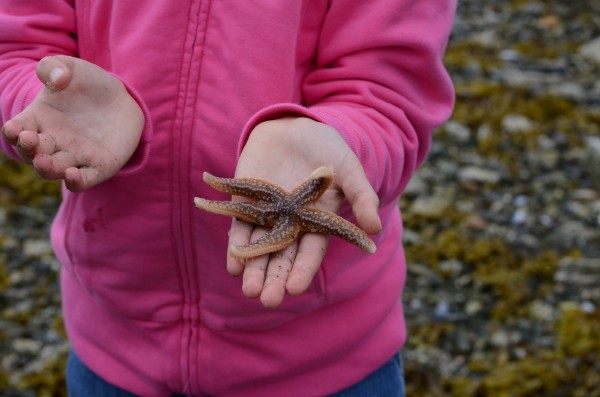
This was really exciting: a sea star missing a ray. I was able to remind the kids about their ability to regenerate that we learned about last year.
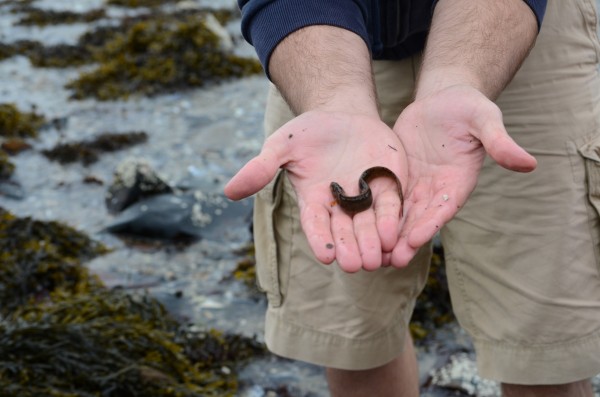
For the record, I did NOT hold this guy. Eels would be a good subject for future study because we didn’t know much about him.
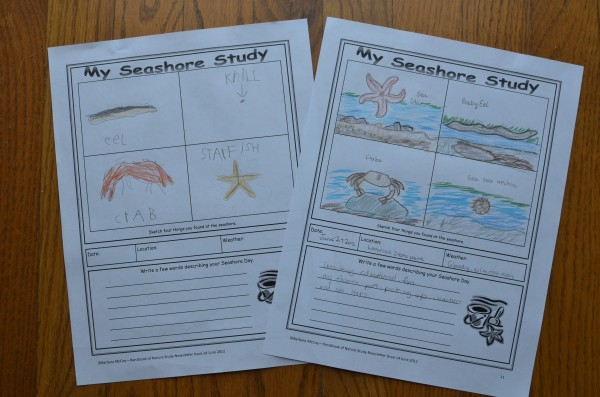
While Daddy grilled lunch back at the camper the kids worked on their journal pages using a free page included in Barb’s Handbook of Nature Study June Newsletter.
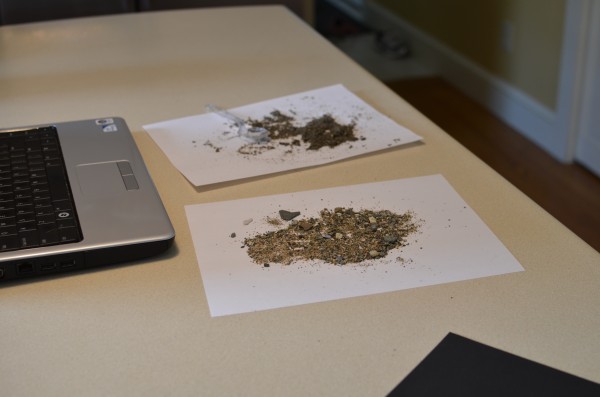
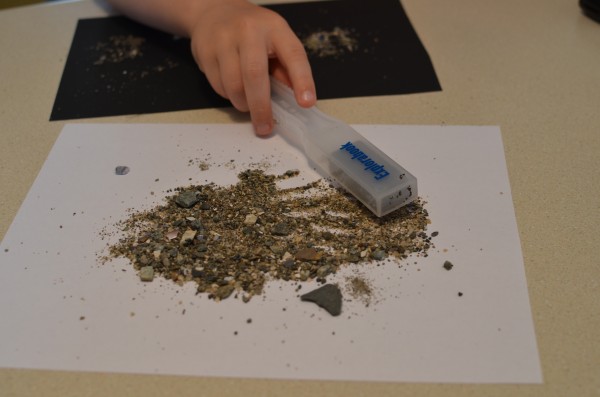
Using ideas from Barb’s Outdoor Hour Challenge: Sand and Soil we brought home some sand to study. I took a sample from higher up the beach and then, at my daughter’s suggestion, another sample very close to the low tide mark. We spread some of each sample out and enjoyed inspecting them on white and black paper using a magnifying glass.
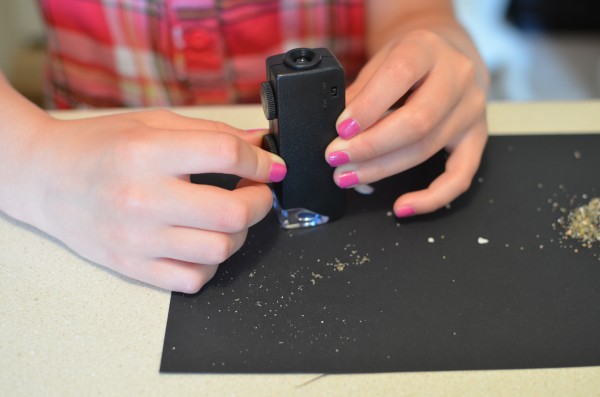
They were impressed when we looked at a piece of quartz under a little hand-held microscope.
My son was completely amazed that some rocks were attracted to his magnet! He spent time when we were done just moving the magnet around over the sand and making rocks move.
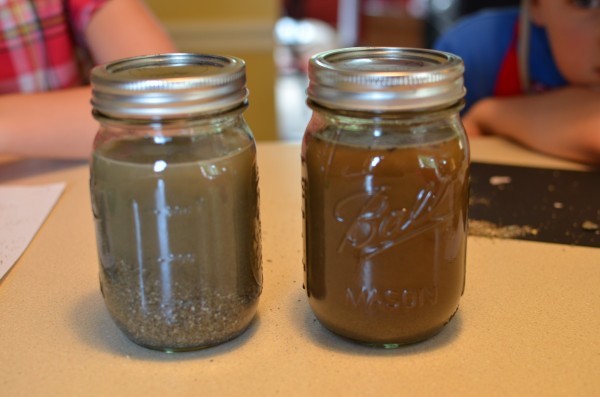
I grabbed some soil from our garden and we performed the soil experiment from Barb’s links. I didn’t get too technical with the kids, but we did talk about how quickly the sand settled, the sizes of particles in the different layers, and as a gardener I talked a bit about the difference soil types can make when you’re planting. I was intrigued by the idea Barb showed of keeping sand samples from different beaches you visit, so this will be our sample #1!
What a terrific week: camping at our favorite spot, time spent with a crazy-fun uncle, and a lot of nature study thrown into the mix. I love summer school!
Last Child in the Woods ~ The NEED for Nature
I’m back with more thoughts on Last Child in the Woods by Richard Louv. Nicole from Journey to Excellence is hosting an informal book study, and you can read her thoughts on Chapter 5, 6, and 7 and Chapter 8. Be sure to head over to her blog to read her thoughts and those of others participating in this interesting book discussion. I was a little behind so I’m here to share my thoughts on Chapters 5-8, which are all in a section of the book explaining why we need nature.
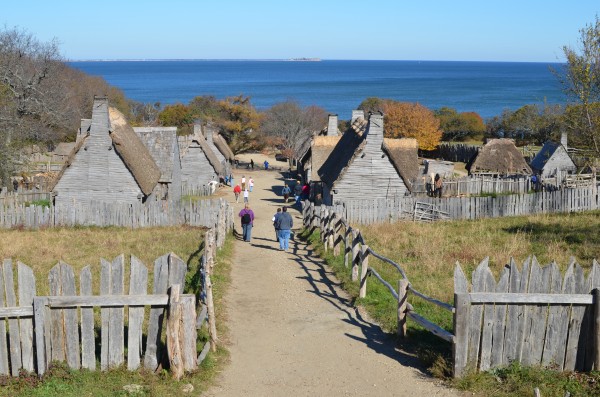
I’d commented at the end of my thoughts on Chapters 1-4 that I thought reading this book would make time in nature move higher up my priority list–and this section of the book has definitely done that! Chapter 5 discussed how nature develops the senses. I was especially intrigued by his thoughts on “primary experience” and how most of what children get these days is dual-sensory information from television and computers, with fewer direct experiences doing and building with all their senses. The section on “packaged nature” reminded me of the difference in listening to a thunderstorm CD versus watching the flashes of lightning and feeling the power of an actual thunderstorm outside your window. I agree with Nicole’s feelings of videos online being far less engaging for my children than a hands-on experience. We had read loads of books and watched shows about the Pilgrims, but nothing cemented it for my kids like our trip to Plimouth Plantation to be immersed with all our senses in what life was like for the Pilgrims.
Chapter 6 delved into the theory of multiple intelligences developed by Howard Gardner, and the relatively recent addition of an 8th intelligence termed “nature smart.” I love the description on page 78: “Perhaps the eighth intelligence is the intelligence within nature, the lessons waiting to be delivered if anyone shows up.” The discussion with a landscape architect talking about designing more natural outdoor spaces had me really brainstorming ideas for my yard. What can I incorporate in my small suburban yard to make it more wild and natural, and thus more stimulating to the senses and imagination?
Chapter 7 talked about “loose-parts” toys that are open-ended, allowing children to use them in multiple ways. This is one of the sections in the book where I found myself generalizing and applying the ideas to not just time in nature, but childhood in general. I have often bemoaned the trend in children’s toys having a single way to play with them. It’s why I’ve always leaned towards things like building blocks and dolls that require imagination and creativity. Coming back to nature, I want to incorporate more “loose parts” for outdoor play and make sure as I garden and landscape around our small yard I am thinking of stimulating my children’s outdoor play.
Nicole was right when she said Chapter 8 was a meaty chapter, and I found myself taking copious notes. Even in the early grades I was struck by how little recess my daughter had at school, and I know it is even worse in other areas. (I had to laugh at the quote: “Lifers at Leavenworth get more time in the exercise yard.”) What I think makes it especially hard for children these days is that when they get home they have homework at a far younger age, and then if you try to add enrichment like music lessons they have even less free time and exercise. I am thankful for the ability to homeschool…if my children were in public school it would be harder to dramatically increase their contact with nature. The reiteration of time in nature as restorative, allowing you to come back with better ability to focus, really hits home for me. My son is a very active boy, and even in preschool the teachers raised questions about his ability to pay attention. Like Nicole mentioned with her son, I am confident he doesn’t have ADHD because he can focus for long periods of time if something is interesting to him. I do notice his attention waning sometimes at home, and up until now I would try to push through and finish our schoolwork so he could then have his free time. My new plan after reading this is going to be to take a break to head outside, and finish the schoolwork with better focus after we’re all refreshed.
There were two other things I took away from chapter 8. One, like Nicole mentioned, was about where we do our schoolwork. The study on the benefits of even a view of nature on focus and concentration was interesting. In a happy coincidence I recently rearranged our schoolroom so both kids have a better view out the windows, but I am going to focus more on what they see out the window. I’m thinking of adding another bird feeder there, or maybe a birdbath. Another piece of information from this chapter requires a little rearranging for me. A work-in-progress study seems to show that a walk in a natural setting is more beneficial than a walk in a manicured residential area. As I said in my earlier post, we get outside nearly every day but usually for a walk around our neighborhood. I am going to make it a goal to head to more natural areas for our walks more often. Like Nicole says, as parents we just need to make the effort.
2011-2012 School Year Review…From My Kids
After all the reflecting I’d done on our homeschool year, I thought it might be interesting to get the perspective of my students, too! I remembered a post I had read last spring about getting input from your kids on Heart of the Matter. Jimmie’s advice was to ask your children questions as you evaluate your homeschool. Armed with her questions I conducted a little interview with each of my children (separately so they wouldn’t be influenced by each other). Some of the answers I completely expected, a few surprised me, and one just made me laugh.
I know math is not my daughter’s favorite subject, so I expected it to top the list on any question about what she doesn’t like. Based on the sheer amount of times she mentioned math negatively I know I have my work cut out for me. I am determined to help her see more of the value in math, and I’m hoping the book my husband and I are both reading, What’s Math Got To Do With It by Jo Boaler, will help.
Both kids listed read aloud time as their favorite part of the day, and their favorite subjects were things we do together. I wasn’t surprised by those answers, but it did reinforce for me what is already in my plan: working together on subjects whenever possible and more reading aloud. Both kids talked about wanting to spend more time studying history, which I’m excited to do as well! It is one of the subjects I am learning right alongside them.
Surprising answers included my daughter’s goal of better grammar (I’m glad I have exciting plans for that for next year), my son’s goal of learning to cook and speak a foreign language (I wouldn’t have guessed those two goals at all–and I definitely want to work on them with him). It was great to get them involved with goal planning and find out what was important to them.
The answer that made me laugh: whenever I asked my son about something he didn’t like, he asked that I “just draw a smile” because he couldn’t think of anything he didn’t like!
While our family was on a long car ride I took the time to discuss the answers with the kids and their dad. We enjoyed a nice, open discussion with everyone together. I think the biggest benefit from this exercise was showing the kids that their thoughts are important. They’re young now, but I hope we’re laying a good foundation we can build upon as they get older and take more of a role in directing their own education.
2011-2012 School Year Review
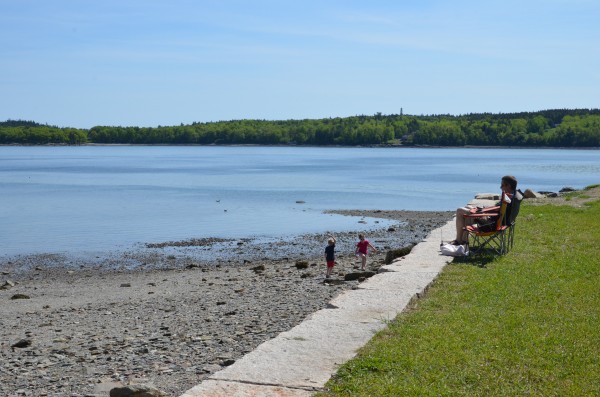
There were times this year when I felt like I’d rearranged things too often…but I tried to remind myself that the beauty of homeschooling was the rearranging: if something isn’t working I can adjust until it works! While camping on the coast of Maine just after we finished full-time school I took the time to really reflect on the year and what my plans were moving forward. Luckily, in spite of all the changes and adjustments and trying to figure things out, one over-riding truth remained: homeschooling is a great fit for our family.
What did work this year:
- All About Spelling: My daughter and I both enjoyed this spelling program and look forward to moving ahead with it next year. The biggest bonus: I can see using it with my son when he’s ready, too. Since my children have such different learning styles, if a curriculum can be used with both of them it offers something for everyone!
- Funnix as a reading program for our son. We are so thrilled with his progress in reading and will continue through all the lessons.
- 50 States Study: This year-long study I put together from various resources was the highlight of our year. My son was actually sad when we finished the last state! We had so much fun learning about our country and its geography, history, and people.
- Nature Study: I may say this too often, but finding Barb’s site The Handbook of Nature Study blog was a God-send. I used her ideas on a regular basis and it’s a very welcome part of our school schedule.
- Working together on subjects: I will continue to combine subjects whenever possible. Both my kids are happier and still learn a lot when working together. It really becomes a bigger part of our life when we are studying the same topics.
- Homeschool book club: A friend arranged this casual group of a few homeschooling families meeting once a month, with each mom taking a turn planning the meeting. Getting together routinely with other homeschoolers was paramount to our success this year.
What did not work at all:
- Writing With Ease: At first we loved it. Then we dreaded it. Why? It felt like the same thing every day. A different piece of literature but doing the exact same thing. Once my daughter got the idea of summarizing the piece in two to three sentences I felt like it was too repetitive. So in December I dropped it, and it became the first purchased curriculum that I gave up on. At first it was disappointing, but then I felt empowered.
- Easy Grammar: This seemed okay at first, but then both my daughter and I learned something about ourselves: we are not worksheet people. This especially surprised my daughter who, coming from public school, had been overjoyed to see workbooks arriving in the mail when I began ordering homeschool supplies. I felt like it was too shallow and mixed up and that the actual teaching of grammar was missing. Plus it wasn’t carrying over into her work, so I dropped that after December. The rest of the year we focused on grammar in her own writing, making index cards with grammar rules. That worked well to some extent…but I still see room for improvement in self-editing. Stay tuned for next year’s plan, because I’m excited!
- Math Workbooks #1: Okay, so maybe we both needed to let go of our attachments to workbooks. I started both kids on Singapore Math. It took a fair amount of prep and teaching time for me, and none of us was enjoying ourselves. Mr. Technology (my husband) had been trying to show us Khan Academy and my daughter and I resisted. When we finally tried it we both loved it. I don’t see a lot of people using it as their curriculum but it works for us. I’m keeping track of the core curriculum standards and standards in our local school district so I can be sure she covers necessary topics, and I try to bring math into real life to solidify what she’s studying. Did I mention it’s also free?
- Math Workbooks #2: For little brother we did finish the Singapore Earlybird Kindergarten Book A. The problem: math concepts on paper don’t work for him. I figured that out early but thought the workbook would help keep me on track with which concepts to cover. It just wasn’t time or money well spent, though. We found computer games and apps and hands-on activities like playing store to be the best way to teach math concepts to him. Bonus: free and he is excited about playing with numbers.
What needed some tweaking:
- Science: Our weekly science class was wonderful and was where we met other homeschooling families. Unfortunately our instructor decided he had too much on his plate and he cut our class. I had already been considering supplementing at home for two reasons: science is little brother’s favorite subject, and although the class and teacher were fun and exciting, I thought my kids could use some building blocks of science that weren’t being covered. So stay tuned for next year’s plan, because I’m excited about this, too!
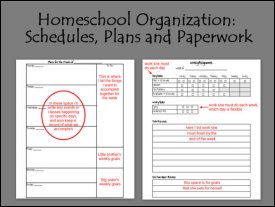
- My scheduling: I started off the year just a bit too uptight. I was nervous and had a schedule typed out down to every fifteen minutes. I kid you not, I had a spreadsheet that showed who was working on what, with a little “M” showing which child I was helping. Honestly, what was I thinking? That left no room for Daddy suggesting we go out for breakfast, the dog throwing up on the carpet, or wanting to play oustide after lunch because it just snowed and it’s that really good sticky snow! Not to mention if a certain subject took a little longer and the other child needed me or didn’t know what to do next. My little schedule went through several redesigns over this first school year, and I finally landed on what works for now: a simple weekly grid with nice big open boxes for each day, plus list boxes for weekly goals. I can write in something happening on a certain day (like a class or piano lesson) and then I just work away at our weekly goals in a flexible way. Maybe today the weather is nice and we’ll do some nature study. Or we feel like flopping down in the living room to finish that book. Or the kids feel like cut-and-paste crafty lapbook work. I based my schedule on this free weekly planner printable I found at The Home School Mom. I just broke up the “To Do” box on the right into three boxes: one box for together work and one for each child’s individual work.
- Tracking school days: I kept meticulous records, but didn’t have benchmarks to guide me throughout the year. I had set a self-imposed goal of finishing our required 175 days before Memorial Day and was determined to meet it. We had to work really hard in April and May to finish on time. It was worth it when we were camping the next week and knew one year was behind us, but I plan to be more prepared next year.
We’re now well into our more laid-back summer school schedule and enjoying ourselves immensely. I’ll post our summer homeschool plans as soon as I get a chance!
Changing My Mind About Report Cards
I had no plans to give my children a report card. I don’t give tests or come up with grades, and besides, I’m the mom and teacher, so who is a report card really for? Isn’t it to tell the parents how their child is doing? Then I was reading on Harmony Art Mom (by the same Barb I’m always mentioning from the Handbook of Nature Study blog–she’s just overflowing with ideas I love) and she referred to a post on narrative report cards. I had to click on the post link and read it, and was immediately persuaded that it was a great idea. My favorite part was how Barb included information about topics other than the basic school subjects in her report card: things like field trips and volunteer work.
Barb has a great sample narrative report card at the bottom of her post, and I followed much of her format with a few variations. For one thing, I don’t have a cool school name or logo–maybe I need one! Secondly, like I said, I don’t give grades and we certainly don’t have credits. I also only intend to do one report card per year. I listed the subject areas very generally: Language Arts, Math, Science, Social Studies, Music, Art, Health/P.E., and then had a space for a narrative in each area. On each of the subject areas I would list how we covered the topics, including curriculum used, any curriculum changes and why, what we accomplished, and goals as we go forward. I also could add in if there is a lot of good effort, or if the attitude could use a little improvement. Then I listed other areas: field trips, literature lapbooks, unit studies, volunteer work, and personal development. Personal development was a fun one that allowed me the freedom to discuss their passions. For example, my daughter sewed a lot this year and really advanced her skills. She took classes, sewed with me, and also attempted (and completed) projects on her own. I appreciated being able to include that kind of information.
It did take a bit of time for me to put together, but it became a wonderful summary of our year: a journal of learning and activities, things accomplished and also things to work on in the future. Reading it over I was proud of all we had done, and I know my children and I will enjoy looking back in years to come.
Last Child in the Woods ~ Free Play and Fear
I had requested the book Last Child in the Woods by Richard Louv from interlibrary loan, and then I saw that Nicole from Journey to Excellence was going to host a book study. How perfect! Today I’ll be sharing my thoughts while reading the first four chapters. Be sure to click over and visit Nicole to read her comments.
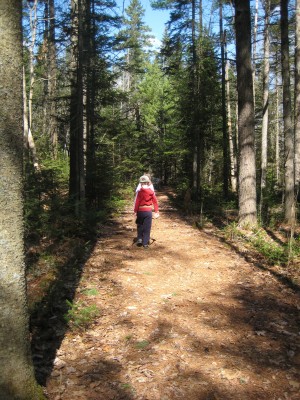
While reading the beginning of the book I was flooded with my childhood memories growing up in a very rural area on old potato farmland. In warm weather I was running around exploring in the woods, rolling down grassy hills, and visiting the frog pond. In winter I was sledding and building forts until my hands were blue. I remember very little of toys I had, but I can replay the sights and smells of the fields and woods in my mind.
After reminiscing my thoughts turned to the way my children are experiencing nature, and I am struck with a difference between my experiences and those of my children. I agree wholeheartedly with much of the author’s discussion of these generational differences, and how much less children are experiencing nature directly now. We are fortunate not to struggle as much with some of the impediments: homeschooling does give us more unstructured time, and we live in Maine with lots of access to natural areas. In Chapter 3 when the author quoted a British study that kids could identify Pokemon characters better than native plant species I gave myself a little pat on the back for incorporating nature study into our homeschool fairly regularly over the last year, and determined to work it in even more in the coming years.
After the pat on the back I felt not so proud in one area: free play in nature. With homeschooling I looked forward to giving my children more time to enjoy time outside, but truthfully free play has not happened as much as I would like. We do walk or ride bikes most days (thanks to our dog), but free play in nature is not as big a part of their lives as it should be. Often I’m with them and tend to be still directing things. I was especially interested the discussions in Chapter 4 on the type of outside environment, and how there does seem to be a difference between outdoor play on a structured playground versus a more unstructured natural setting. This is one area that is difficult because we live on a small lot in a relatively new subdivision with mostly lawns and gardens and no wooded areas. I’m afraid there isn’t as much nature to fuel the imagination in our backyard as there is in a less manicured area. I have to take them to more natural places, and when I do our time is limited by me wanting to get back home to my lengthy to-do list. I don’t want my responsibilities as an adult to shorten their time to be kids and experience the same play time I had as a child, but it really is difficult.
Other than my feeling the need to be home to get things done, the other barriers to unstructured time in nature for my children is my fear. I have a hard time if they’re playing where I can’t see them. I fear they’ll get hurt and I won’t be there to either prevent it or help when it happens. Add to that a fear I am especially struggling with this summer: ticks. I have had ticks on me recently, and I have a friend recently diagnosed with Lyme disease. I hate to douse ourselves with chemicals in order to spend a little time in the woods, but reading the many benefits in this book may push me to try getting out in the woods more, even if a hefty dose of DEET has to go with us.
As I read Chapter 4 about nature’s healing properties, I remembered during my teen years taking walks in an old farm field across the road. Once I walked out into it and over the hill, I couldn’t see a single house. It was just me and the wind and the wildflowers. It was so calming and a great time to think. I have seen days in our homeschool that just are not going well and time outside (especially in the woods) has saved the day. I am determined to use nature more to benefit both myself and my children.
I’m very excited to continue reading this book. It reminds me a bit of my feelings when reading The Read-Aloud Handbook by Jim Trelease. I already read a lot to my children, but that book reinforced for me the many benefits of it and assures that time for read-aloud will not be the first thing we cut if we’re low on time. I have a feeling time in nature will also be higher on my priority scale after finishing this book.
Nature Study–No Planning Needed!
Nature study is one of my favorite parts of the Charlotte Mason philosophy. We try to incorporate it as much as we can, with many of my ideas coming from Barb at the Handbook of Nature Study blog. One of the most common ways we fit in nature study, however, takes no pre-planning at all. You could call it interest-led or on-demand or lucky coincidence…
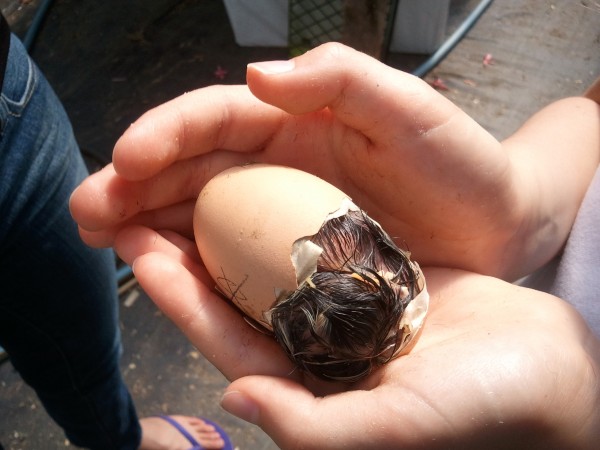
When we see something in nature that we’re curious about we spend time researching it. I know, amazing thought, right? And it really is that simple. The more complicated side is putting aside my plan or list and being willing to detour and slow down. It means when we are at our small town’s garden store for what is supposed to be a twenty minute shopping trip being willing to stay an hour and a half so my daughter could hold a chicken egg in her hand while it hatched. It means dropping the load of laundry to run to the window and see the bird at the feeder. It means crouching down on our neighborhood street (when I’m really just trying to get our dog some exercise) to watch a snail. It means stopping the lawnmower, grabbing the bug box and finding a way to get a huge green beetle inside it. (And yes, I did let out a squeal when he touched me.)
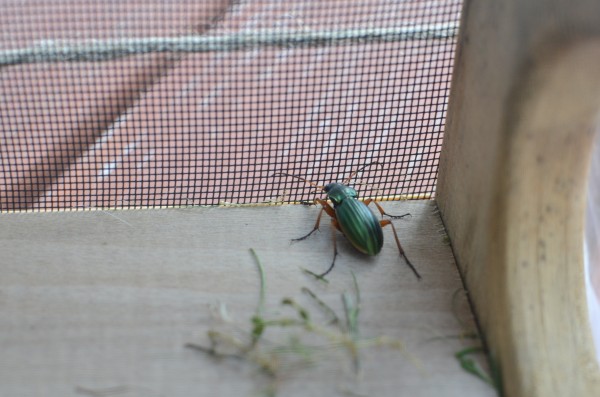
There is a great benefit to this method even aside from the easiness of it. Not only do we learn a lot about the natural world without tons of planning on my part, but it fosters my children’s curiosity. It has encouraged them to call out to me: “Hey Mom! Look at this! What is it?” I always try to go and see it. If we can we bring it home to study (like the garden snails I carried in a dog waste bag), otherwise we take a picture (great use for the camera on my phone).
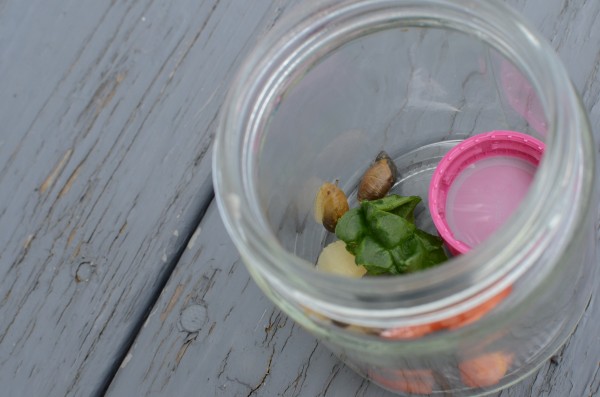
At home we follow through and find out what we can about our topic. I love having field guides and reference books on trees, insects, and birds around the house so we can grab those and start thumbing through to track down our item of interest. (As a side note: building a reference library doesn’t have to be expensive: most of our books I’ve picked up on clearance or at used book sales.) This can help with beginning identification on things like the big green beetle where I don’t know what to type in for an internet search. If we’re not positive of the identification based on the drawing or picture in our field guide, I’ll often do a Google Images search and compare the images with what we found to help us be sure. For birds you can’t beat Cornell’s All About Birds website to identify and then learn everything you wanted to know, and even watch a video or listen to audio recordings. If it’s just a feather you find, then check out the Feather Atlas from the U.S. Fish and Wildlife service. The Discover Life site has ID nature guides that cover just about every living thing. This site is so detailed it can be a little harder to navigate, but many of the guides have photos to make it easier. For instance, under insects you can choose caterpillars, then using the photos select the main body color, pattern, and other features to arrive at an identification.
That would be how I identified the caterpillar that gave my son an awful rash. Oh, and that was after my husband said, “I thought you weren’t supposed to touch hairy caterpillars.” I waived away his concerns, saying surely in rural northern Maine where I grew up we touched all sorts of them. I let the kids play with them for a couple hours, draw them and build them houses. Let me just say that I was really eating my words at 2:00 AM when my son was itching and crying covered in hives. My dear husband didn’t even say “I told you so,” though I really deserved it!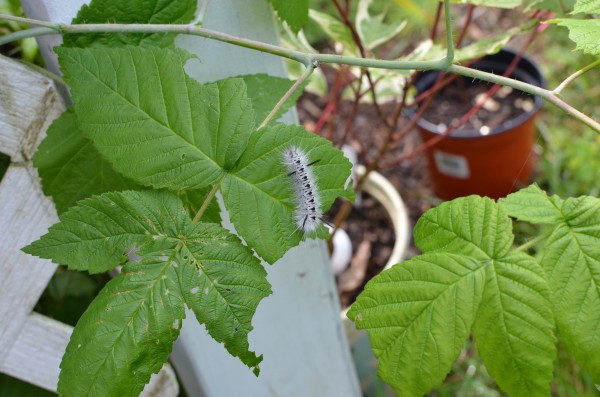
My favorite nature reference book that we own is The Handbook of Nature Study by Anna Botsford Comstock, an amazing book originally written in 1911. It doesn’t have color photos like most field guides, but it’s loaded with interesting information. That’s where we pick up fascinating in-depth knowledge, like how the bleeding heart flower has a hinge to expose the pollen while bees are drinking the nectar. Barb’s Handbook of Nature Study site is a great place to find educational links and study activities if you want to dig deeper. It was through links on her site that we learned a garden snail can have over 400 babies in a year (and why the garden snails we brought home were returned to their previous area!) And if it’s something my kids are still showing a lot of interest in, we’ll grab books on it at the library and read until their curiosity is satisfied.
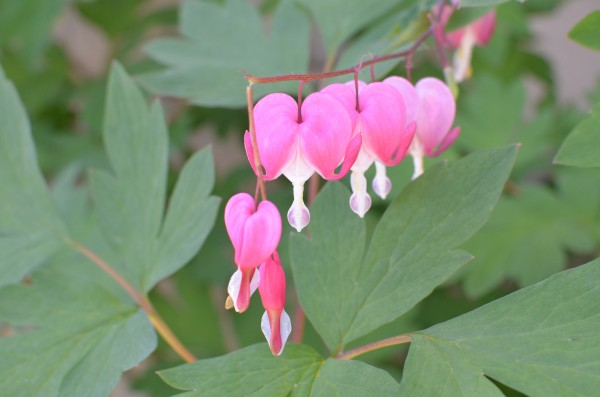
At least until the next time I hear: “Hey Mom! You’ve gotta come see this!”
Hi, I'm Heidi and I homeschool my two sweet kids. I want them to know that learning is an exciting lifelong adventure! We love great books, unit studies, notebooking, lapbooking, and hands-on learning.